
Slavery & Trafficking
"bury me not in a land of slaves" (l.32)
Frances Ellen Watkins Harper's "Bury Me in a Free Land' (1858)
Points
for Reflection
E. B. Browning's "The Runaway Slave at Pilgrim's Point" (1846; 1848, 1850)
- EBB originally opened this poem with four italicized stanzas voiced by the narrator's male lover. Would you like to hear his perspective too, or is the female narrator's voice the one on which we should focus?
- What central tension does E.B.B. establish in stanza one?
- Who constitutes the auditor for this poem, in its opening? At what point does the intended auditor change?
- What provides the subject matter of the one song the narrator knows, and at what points does she prove unwilling to sing it?
- Is E.B.B. concerned more with creating a sense of high fidelity (realism) in this poem, or with shaping an emotionally and aesthetically effective polemic?
- Can we deduce what happens to the narrator's lover?
- How does the narrator's devotion to God change in response to the abuse she received at the hands of her owners?
- Do lines 138-40 constitute an indictment of miscegeny?
- What happens to the narrator's child, and why?
- Unpack the paradox of lines 146-47.
- Consider the central metaphor of stanza twenty-three: if "fruit" is the vehicle (ground), what is the tenor (figure)?
- What is the dominant tone of stanza twenty three? Celebratory? Bitter? Something else?
- How do the angels respond (at least, in the imagination of the narrator) to the narrator's surprising actions?
- Is the reader encouraged to either pity or scorn the narrator?
- What are the five men who find the narrator preparing to do (l.211)?
- Do lines 212-15 constitute a curse or blessing?
- Towards what action is the narrator calling her fellow slaves (ll.229-32)?
- Should the reader agree with the narrator that she is "not mad" (l.218), but perfectly sane?
- What does the narrator mean by the statement, "Our wounds are different" (l.239)?
- Does the narrator curse her captors in the poem's close?
E. B. Browning's "Hiram Powers' Greek Slave" (1850)
- Can this poem be easily categorized as either an English (Shakespearean) or Italian (Petrarchan) sonnet?
- E. B. B.'s narrator imagines the sculptor of this work deliberately creating a polemical work of art that carries what message?
- What practical power does this narrator attribute to Art?
- Does the poem suggest that the influence of this work of art is bound to a particular culture and nation, or that its impact could be universal?
- Why, according to the narrator, is it important that this victim of slavery take such an ideal, beautiful physical form?
- Does this poem constitute a celebration or critique of the sculpture in question?
J. M. Whitfield's "The Misanthropist" (1853)
- What is Whitfield’s narrator currently unable to accomplish?
- What roadblock prevents the narrator from achieving the goals others expect him to reach?
- Does the narrator see his condition as akin to that of others?
- What refuge does Nature offer the narrator?
- Do the dreams brought by sleep frustrate our narrator, or delight him? What are the “specters of still sterner mood” (l.37) to which he alludes?
- What does he seek out in the historical record?
- What two different things might “my spirit seemed to soar’ (l.91) mean?
- How hwas the narrator's opinion of religion shifted over time, and why?
- Has romantic passion provided the narrator either respite or inspiration?
- Do you sympathize with the narrator’s plight? Does his loneliness seem enforced on him, a free choice, or some mixture of both?
- Do the poem’s closing three words, a prepositional phrase, reveal anything important?
F. E. W. Harper's "The Slave Auction" (1854)
- Does Harper's poem attend equally to black folk of both genders?
- Under what conditions might a loved one's death be considered a blessing?
- Does the poem configure one parental sex as more active than the other?
F. E. W. Harper's "Bury Me in a Free Land' (1858)
- Does our narrator seek notoriety in death?
- She compares the state of death to what other states of being?
- What does the narrator imagine still being able to do once dead?
- Does the use of metaphor and simile intensify or dilute the pain described in lines 13-16?
- Does Harper point the accusing finger at the slavers themselves?
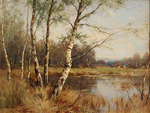
Birches by the Marsh (c.1890)
James Edward Grace
Dr. Paul Marchbanks
pmarchba@calpoly.edu


